

Outdoor CCTV Tower Hire for Events UK: What to Plan Before You Book
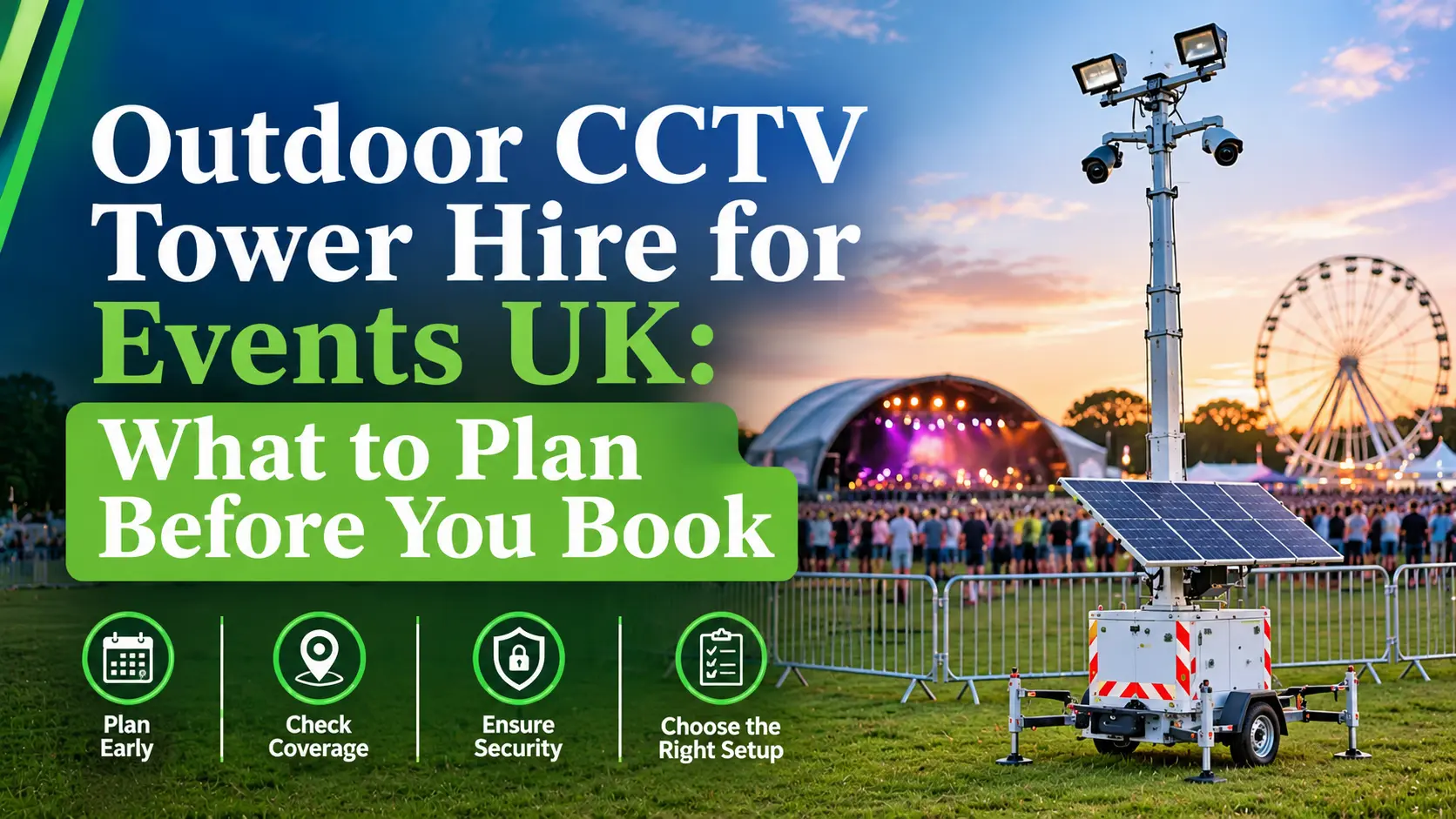
An event field is a temporary site with a permanent problem. You have a perimeter made of fencing, valuable kit on open ground and thousands of visitors, with no fixed cameras anywhere. That is the job temporary CCTV installations are built for, and the planning decides whether they work.
This guide is for organisers, security companies and site managers. It follows the order of questions an engineer would ask on a site walk, so you can use it as a checklist when you speak to suppliers.
Check 1: What are you protecting, and from whom?
Start with a list of assets, not a number of cameras. Staging, generators, fuel, bars, cash handling, artist compounds and the gates themselves each carry a different risk. Write them down, then write down who might want to get at each one.
Picture a two-day music event on a farm field. The crowd is the obvious concern, but the stage rig and the generator compound are worth far more than anything in the bar tent. Your coverage should reflect that.
Before the gates open: build and de-rig
Build and de-rig are the quiet, exposed weeks. Trailers, rigging and plant sit on an open field with few people around, so theft and trespass are more likely than during a busy show. Cover this phase first, and ask whether towers can stay put or need to move as the site fills.
While the event runs: crowds and entry points
Once the public are in, the risks shift to entry points, queues, car parks and weak spots in the fence line. Cameras here help a control room see build-ups early, and they give you footage if something goes wrong. Cover every entrance and every route out, because that is where people bunch up.
Check 2: Where should the towers stand?
Where a tower stands matters more than how many you hire. A tower in the wrong spot records a very clear picture of a tent. Walk the site with the event plan in hand and mark what each tower must be able to see.
Sightlines and blind spots
A tower sees what is in front of it. Stages, marquees, lorries and temporary structures create blind spots that do not exist on an empty field, so check sightlines against the build, not the site plan alone.
For restricted areas such as artist compounds or fuel stores, perimeter detection for restricted areas can raise an alert when someone crosses a line. That is better than relying on a person to spot it on a screen.
Ground, access and crowd flow
Soft ground, slopes and cable runs all affect where a tower can physically go. Keep towers clear of emergency routes and out of reach of the crowd, with room for engineers to get in. Agree positions with your safety officer before they are fixed on the plan.
Check 3: How will the towers get power and a signal?
Event fields rarely have power or signal where you need cameras. Solar-powered CCTV towers are designed for sites without a nearby supply, so they can stand where a cable would never reach.
The signal is the second half of the problem. Cameras need a route back to whoever watches them, and at a busy event thousands of phones share the same local network. Ask how the towers connect and what happens to the feed if that connection slows.
Check 4: Who watches the cameras, and who responds?
Cameras only help if someone sees what they record. There are two basic set-ups, and the right one depends on what you need to do with the footage.
| Record-only | Monitored | |
|---|---|---|
| What it does | Records footage to review after an incident | Someone watches live and raises the alarm |
| Best suited to | Build and de-rig, quieter areas, evidence | Entrances, crowds, restricted areas |
| Watch out for | Nobody is looking while it happens | Needs a named person and a response plan |
Quantum offers optional 24/7 remote monitoring integration.
Monitoring is only half of it. Someone has to act on an alert, whether that is event security, a police liaison or the site manager. Write the chain down as alert, monitoring, response, with names and phone numbers.
If contracted staff watch live footage of the public, they may need a licence from the Security Industry Authority. GOV.UK explains when an SIA licence is needed, so check before you appoint anyone.
Check 5: What do data protection and event rules expect?
Cameras that record identifiable people bring legal duties with them. Two areas catch event organisers out: data protection and, from 2027, Martyn’s Law.
Signage and data protection
The ICO’s guidance expects people to know when they are in an area under surveillance. In practice that means clear signs at the entrance to the area, backed up by more signs inside. It also expects a data protection impact assessment where the processing is likely to be high risk.
Read the ICO’s CCTV and video surveillance guidance before you finalise your plan, noting that the ICO has it under review following the Data (Use and Access) Act 2025. Agree who is the data controller for the footage too, because that decides who answers a request for a copy.
Martyn’s Law and your event plan
Martyn’s Law is the Terrorism (Protection of Premises) Act 2025, and it applies to events as well as premises. GOV.UK says the Act is expected to come into force in spring 2027, with the SIA as regulator.
Whether your event is in scope depends on the Act’s criteria, so read GOV.UK’s guidance on Martyn’s Law and the SIA’s role rather than assuming either way. Cameras can support an event security plan, but they do not replace one.
Check 6: When should you book outdoor CCTV tower hire for events UK?
Book once the site layout is settled, because siting, power, signal and monitoring all depend on it. A rushed booking usually means compromises on tower positions. Quantum’s rapid deployment, in hours rather than days, helps when plans change, but good siting still needs time.
Here is how the timeline usually runs, from first plan to de-rig.
| Stage | What happens |
|---|---|
| Planning | The event plan and layout are agreed, and you decide what the cameras are for |
| Site walk | Tower positions, power and signal are checked on the ground |
| Quote and sign-off | Positions, monitoring and responsibilities are agreed in writing |
| Delivery and commissioning | Towers are placed, tested and handed over before the build or gates |
| Live event | Footage is recorded or monitored, with technical support on call |
| De-rig | Towers are collected once the site is clear |
Check 7: What should the quote include?
A quote should tell you what you get, not just what you pay. Ask for it in writing and check that these lines are covered:
- Number of towers, with positions marked on your site plan
- Power arrangement and any backup
- Connectivity, and what it assumes about crowd size
- Recording, retention period and who can access footage
- Monitoring: who watches, when, and who they call
- Delivery, installation, removal and the hire period
- Technical support during the event, including out of hours
Quantum’s engineers are all in-house, with no subcontracted engineers and no outsourced call centres. Support runs 24/7, and you can read more about installation and technical support before you ask for a quote.
What to ask about outdoor CCTV tower hire for events UK before you sign
These questions tend to separate a considered quote from a price list:
- How long does it take to move or add a tower once the event is live?
- What happens if a tower loses signal or power overnight?
- Can footage be exported quickly for the organiser or the police?
- Who is on call, and can I speak to an engineer rather than a call centre?
- Which parts of the quote are fixed, and which change if the event does?
How to compare temporary CCTV tower providers
Compare like with like. Put each quote against the seven checks above and mark where a provider has left a line blank. A cheaper quote that leaves out monitoring, backup power or collection can cost more by the end of the weekend.
Ask whether the people who install the towers are the people who support them. That answer tells you who you will be talking to at two in the morning.
FAQ
How far ahead should you book CCTV towers for an event?
Book as soon as the site layout is fixed, because positions, power and monitoring all depend on it. Quantum offers rapid deployment, in hours rather than days, but an event needs positions agreed and signed off first.
Do CCTV towers at events need mains power?
Not necessarily. Solar-powered towers are designed for fields without a nearby supply, so ask your supplier how power is handled and what backup exists for outdoor CCTV tower hire for events UK.
Do you need CCTV signs at an outdoor event?
If your cameras record identifiable people, yes, in practice. The ICO’s guidance expects clear signs at the entrance to the area, reinforced by more signs inside.
Who monitors CCTV towers at an event?
That depends on the set-up. Some events record only, while others want live monitoring with a named person and a response plan. If contracted staff watch the public, check whether they need an SIA licence.
Can towers be moved while the event is running?
Treat that as a question for your supplier before you book, not a decision for the day. Ask how a move works, who authorises it and how long it takes.
Planning an event? Talk it through with an engineer
If you want a second opinion on tower positions, power or monitoring, call Quantum on 0333 888 0007 or email comms@quantumcctv.co.uk. You can also request a quote with your site plan and dates, and we will tell you what we would check first.