

How to Secure a Solar Farm Perimeter: A Layered Approach for UK Sites
A fence to slow intruders, detection to raise the alarm, and cameras to confirm what is happening before anyone is sent.
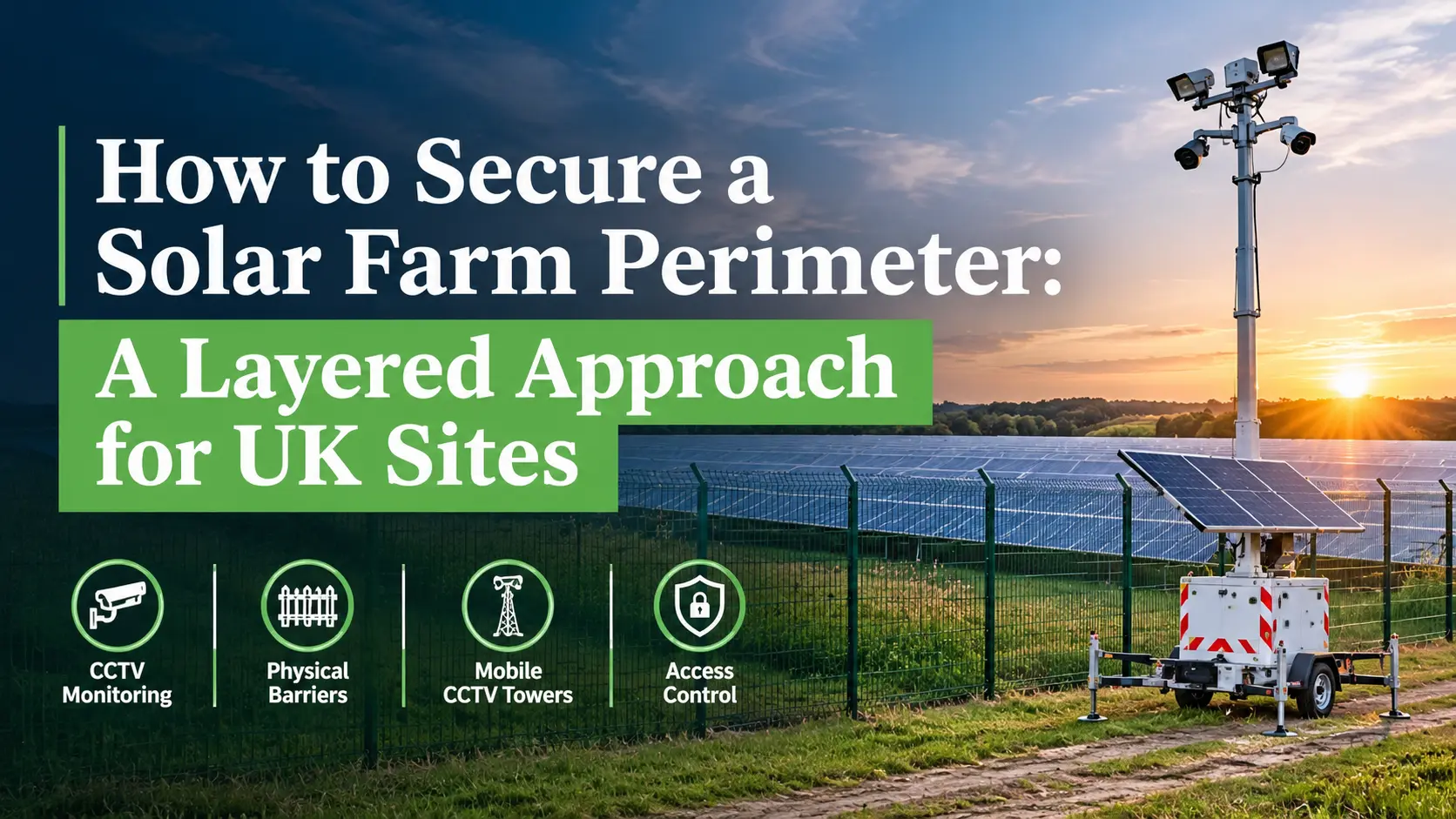
Most solar projects start the security conversation with the fence. It is visible, easy to specify and easy to tick off. But a fence only delays; it never tells you someone is there.
This guide covers the layers, how they change from construction to operation, and what to check before you specify anything. If you want the detection layer in detail, our perimeter intrusion detection system page explains what we supply.
Why is solar farm perimeter security harder than it looks?
A solar farm is a valuable site with nobody standing in it. Panels, cable and inverters are all worth taking, and they sit behind a very long boundary.
Long boundaries and nobody on site
Walk the edge of a large site and the problem is obvious. There may be one locked gate, then a long run of fence, hedge and ditch that nobody looks at for days. Intruders rarely need the gate; a quiet stretch and a pair of cutters will do.
The longer the boundary, the less a patrol can cover. That is why protection on remote sites tends to lean on sensors and cameras rather than people alone.
Planning limits on how imposing a fence can look
Solar farms sit in the countryside, and the planning process pushes security to blend in. Police crime-prevention responses to solar applications have favoured fencing that sits quietly in the landscape, such as green mesh, and planted boundary buffers Planning applications for solar farms often propose low-key rural fencing to protect the landscape. In one 2024 Nottinghamshire planning response, a police Designing Out Crime Officer advised against deer fencing on an isolated site and suggested 2.4 metre green welded mesh as a less obtrusive secure option (Nottinghamshire Police planning response). The same response warned that CCTV achieves little unless it is monitored and can raise an instant alert.. That suits the landscape, but it means you cannot count on a tall, intimidating fence to do the deterring.
How to secure a solar farm perimeter in four layers
Think of the perimeter as four jobs: delay, alert, verify and respond. Each layer covers a weakness in the one before it.
Layer 1: fencing and gates
The fence and gates buy you time. Use secure fixings and tamper-resistant locks on access points, because a chain is easy to cut. Treat the fence as the layer that slows someone down, not the layer that stops them.
Layer 2: detection
Detection is the layer that tells you when someone reaches the boundary. A perimeter intrusion detection system (PIDS) uses sensors to spot a person crossing, climbing or cutting, and sends an alert. The sensors come in a few types: perimeter security sensors fixed to the fence, beam sensors that trigger when something breaks a line, and camera-based detection that watches a zone.
We compare the main types further down.
Layer 3: cameras
An alert on its own is only a signal on a screen. Cameras show what caused it, so the person watching can tell an intruder from a fox or a branch. That is what stops every alarm becoming a call-out.
Layer 4: monitoring and response
Someone has to receive the alert and decide what happens next. That might be a monitoring centre, a mobile patrol, the police or your own site team, depending on how the site is set up. Agree who does what before the system goes live, not after the first alarm. [CONFIRM: whether Quantum monitors alerts itself or hands them to the client’s alarm receiving centre]
How should perimeter security change from construction to operation?
The same boundary needs different protection at different stages, and the awkward middle is easy to overlook.
Construction phase
During construction, panels, cable and plant arrive long before the permanent fence, power and communications are finished. The boundary may be partly open, and the site is busy by day and empty at night.
That is when temporary protection earns its place. Temporary CCTV for construction phases can cover the gap, and rapid deployment, in hours rather than days, means it can start when the equipment does.
Energised but unmanned
Once the site is generating, the permanent fence is up but the site is usually empty. Detection and camera verification now do the job that people on site did during the build. This is also when you find out whether the alert chain actually works.
Long-term operation
In normal operation the system should need little attention and still be worth acting on. That means regular checks of sensors and cameras, vegetation kept clear of detection lines and a named person who owns the alerts. Our in-house engineers and 24/7 technical support look after the equipment side.
Beam, infrared and fence sensors: which suits which boundary?
There is no single best sensor. Each type suits a different part of the boundary, and many sites combine two or three.
| Sensor type | How it works | Suits | Watch out for |
|---|---|---|---|
| Fence-mounted sensors | Pick up vibration or movement on the fence from cutting or climbing | Boundaries where the fence is the line you want to protect | Wind, vegetation or livestock rubbing the fence |
| Beam sensors, including infrared perimeter security systems | Send a beam between two points and alert when something breaks it | Gates, gaps and approach routes | Need a clear line of sight; growth and terrain can interrupt it |
| Camera-based detection | Software watches a zone and flags people or vehicles | Open areas where you want to see as well as detect | Needs good coverage, lighting and power |
[CONFIRM: which of these types Quantum supplies, so the post only recommends what we can deliver]
On a typical solar boundary you might use fence sensors along the main run, beams across gates and gaps, and cameras at corners and access points. Perimeter beam security works best with a clear line of sight, so plan for where vegetation will be in summer, not just on the day of the survey.
How do you secure a remote solar farm without mains power?
Remote sites often have no convenient mains supply or communications at the boundary. Running power and data out to a far corner can add cost and delay.
Solar-powered equipment avoids that problem. Our solar-powered CCTV towers can be deployed in hours rather than days. [CONFIRM: mains-free and no-groundworks wording for towers and PIDS equipment, battery runtime and connectivity options]
That makes them useful during construction and on sites where the permanent supply is not yet connected.
How do you cut false alarms so detection is worth acting on?
A system that cries wolf gets ignored, which is worse than having none. Many false alerts come from the environment: wind moving a fence, vegetation growing into a beam, animals crossing a zone or heavy rain.
You reduce them by splitting the boundary into zones, keeping detection lines clear, tuning sensitivity after installation and using camera verification so a person checks before anyone is sent. [CONFIRM: basis for any claim that Quantum’s PIDS reduces false alarms]
Checklist before you specify a perimeter system
0 of 8 considered
- Boundary length and shape, and where it is hardest to see
- Number and type of access points
- What power and communications exist at the boundary today
- Whether you need protection during construction, operation or both
- Who receives alerts and who responds
- What your insurer expects for the site
- Planning conditions that limit fencing, lighting or equipment
- How the equipment is maintained and who to call when it fails
FAQ
Is a fence enough to secure a solar farm?
No. A fence delays an intruder but does not alert anyone. Add detection so you know when the boundary is reached, and cameras so you can confirm what caused the alert.
What is the best way to detect intruders at a solar farm perimeter?
There is no single best method. Fence-mounted sensors, beam sensors and camera-based detection each suit different parts of the boundary, and many sites combine them. The right mix depends on boundary length, terrain, vegetation and the power and communications available.
What is the difference between perimeter detection and CCTV?
Perimeter detection raises an alert when someone reaches or crosses the boundary. CCTV shows you what is happening. Used together, detection tells you when to look and cameras tell you what you are looking at.
Can you secure a solar farm without mains power?
Yes. Solar-powered detection and CCTV equipment can run without a mains connection, which helps on remote sites and during construction. Check battery capacity and connectivity for the specific site.
When should security go in: during construction or after energisation?
Plan it for both. Panels and cable arrive before the permanent fence, power and communications are finished, so temporary protection can cover that gap until the permanent system is live.
Talk Your Solar Site Through With Our Team
If you would like to talk a site through, call 0333 888 0007 or request a quote. Tell us the boundary length, the project stage and what power you have, and we will tell you plainly what we would put where.